What Is a Time Zone? A Plain-English Explanation

Okay, let's talk time zones. Not the textbook version you half-forgot from school — the version you actually need when your colleague in Chennai keeps joining the standup at 11 PM. (Yes, that's a real story. We'll get there.)
The short answer
A time zone is basically a region of the world that agrees to use the same local time. The sun rises at different moments depending on where you stand, so somewhere along the line humanity decided: "let's not all just pick random clocks, let's chunk the planet and give each chunk an offset from a common reference."
That common reference is UTC — but that's its own post. For now, think of a time zone as "how many hours (and sometimes minutes!) your local clock is ahead of or behind UTC."
Why we even need them
Back in the day, every town basically ran on its own sun time. Noon was whenever the sun was highest, and nobody cared that the next town over was a few minutes different. That worked fine until trains arrived and suddenly timetables became a nightmare. You can't run a railway when every station has a different "12:00".
So in the 1800s the world standardised — the Greenwich Meridian became the anchor, and the planet got sliced into roughly 24 time zones, one per hour. It's not perfectly even, and honestly it never was, but it fixed the trains.
Offsets aren't always whole hours
Here's where it gets fun. You'd think every time zone is a clean UTC+1 or UTC-5, right? Nope.
- India is UTC+5:30. Half an hour. Because of politics and history, not science.
- Nepal is UTC+5:45. Forty-five minutes! It's one of only a few places on Earth with a :45 offset.
- Australia has three different offsets across its states at once. Good luck with a national meeting.
So when someone says "let's sync at 3 PM your time," the math is rarely a clean round number. That's the whole reason apps like ClockHive exist — because humans are awful at adding 5:30 to things.
A real example, because this is personal
I once worked on a team spread across London, Chennai and Sydney. We naively scheduled the daily standup at 3 PM London time. That meant Chennai was at 8:30 PM (fine-ish) and Sydney was at 1 AM the next day. The Sydney dev joined for exactly one standup looking like a zombie, then we fixed it. The lesson: don't schedule for one timezone and hope the rest cope.
Check the overlap, not just your own clock. Most of the time there's a two-hour window that works for everyone — it just requires looking at all three cities at once, not guessing.
Same moment, different clocks
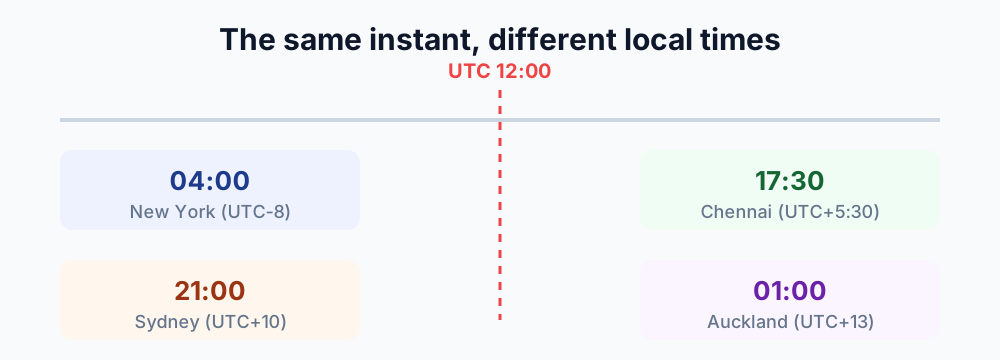
That red dashed line is the same instant in all four cities. Same moment in the universe — four different numbers on the wall. This is the mental model that makes remote work survivable.
Quick answers
Is a time zone the same as an offset? Not quite. The offset is the number; the time zone also includes rules about daylight saving, history, and political boundaries. But for everyday life, "time zone = offset" is close enough.
How many time zones are there? More than 24! Because of half-hour and :45 offsets plus weird political splits, the real count is around 37-38 across the world.
Why is my friend's "same time" always different? Because their offset from UTC is different. The sun doesn't care about your meeting.
Tip: Open two or three cities in the ClockHive Business Hours tool before your next cross-timezone call — it shows you the shared window instantly instead of doing mental math.
Helping remote teams and global professionals master time zones. We build tools that make distributed work effortless.
🌍 Never miss a timezone tip
Get the latest guides on remote work, timezone management, and global team productivity.
Create Free Account