What Is Daylight Saving Time? Spring Forward, Fall Back
Twice a year, the world quietly moves the clocks and half of us lose or gain an hour of sleep. That's Daylight Saving Time — or DST if you want to sound like you're in a hurry. Let me break down what's actually going on, because honestly the confusion around it is well-earned.
The basic idea
The concept is simple: in summer, when the days are long, we shift the clocks forward an hour so the sunlight is "used" later in the evening. Sunrise comes later, sunset comes later, and you get an extra hour of daylight after work. In autumn, we shift back.
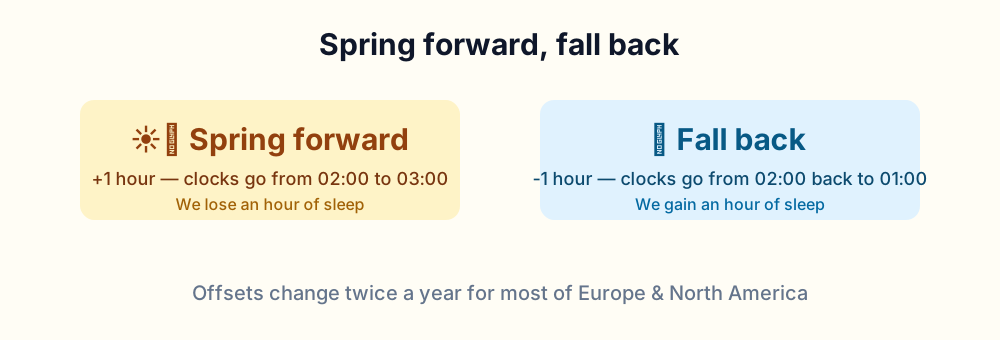
Hence the mantra: spring forward, fall back. Spring = clocks go forward (+1 hour, lose sleep). Fall = clocks go back (-1 hour, gain sleep).
Why it exists (and who actually wanted it)
People love to blame Benjamin Franklin, who jokingly suggested something similar in 1784 as a way to save candles. But the modern version really took off during World War I, when countries wanted to save fuel and energy by making evenings lighter. The idea stuck around, energy debates aside.
Honestly, the energy-saving argument is shaky these days — studies keep going back and forth on whether it saves anything at all. But the tradition is deeply embedded, so we keep doing it. Some places even tried to abolish it (more on that in a second).
Who does and doesn't do it
Here's the part that makes global scheduling painful — it's not universal, and it's not even consistent within countries.
- Most of Europe observes it (and changes on the same dates).
- Most of North America observes it — except Arizona (except for the Navajo Nation, of course) and Hawaii.
- Most of Asia and Africa don't observe it at all. India, China, Japan, Singapore — no DST. The clocks just sit there.
- Australia does it in some states and not others, on dates that don't line up with the northern hemisphere at all.
So in our London–Chennai–Sydney team, London and Sydney both change their clocks — at completely different times of year — while Chennai never changes. Which means the offset between London and Sydney isn't even constant. It drifts. That's the actual nightmare.
The scheduling gotcha (and the coding gotcha)
The classic mistake: you schedule a recurring 3 PM meeting, and the week the clocks change, it quietly moves to 2 PM or 4 PM for your colleagues on the other side of the change. Nobody notices until someone misses it.
And if you're writing code, DST is where timezones go to break things. A wall-clock time like "02:30" can occur twice on the fall-back day, or not at all on the spring-forward day. If your app stores local times without an offset, you get bugs that only appear twice a year. This is why we store UTC and convert at the edge — DST can't touch UTC.
The two moments
Quick answers
When does it change? Europe: last Sunday of March and October. US: second Sunday of March, first Sunday of November. Different places, different rules — always double-check the specific country.
Is DST the same everywhere? No. Dates differ, and lots of countries don't do it at all.
Is it being abolished? It gets proposed all the time. The EU voted to end it (then got stuck on the details), and some US states want to make it permanent. Nothing's actually changed for most of us yet.
Tip: When a timezone changes its clocks, the offset between cities changes too. Keep a ClockHive tab with your team's cities open and re-check the overlap after any DST weekend — it probably moved.
Helping remote teams and global professionals master time zones. We build tools that make distributed work effortless.
🌍 Never miss a timezone tip
Get the latest guides on remote work, timezone management, and global team productivity.
Create Free Account