What Is Agile Methodology? The Mindset, Not the Checklist
Agile is one of those words that means everything and nothing these days. Companies slap it on job titles, tools, and process decks. But underneath all the noise, Agile is a genuinely simple idea, and once you see it, you can't unsee it. Let me strip it back.
The one idea at the core
Agile is a mindset for doing complex, uncertain work: deliver small pieces frequently, get feedback fast, and change course based on what you learn. That's it. Everything else — the meetings, the boards, the ceremonies — is just scaffolding around that idea.
The opposite is the old way, usually called Waterfall: plan everything up front, build it all, then reveal it at the end. That works great when you know exactly what you're building. It collapses when you're building something nobody's built before — which is most software.
The Manifesto, in plain words
In 2001, seventeen software folks got together and wrote the Agile Manifesto. It's famously short, and it boils down to four value shifts:
- People and interactions over processes and tools.
- Working software over comprehensive documentation.
- Customer collaboration over contract negotiation.
- Responding to change over following a plan.
Notice the phrasing — it's not "processes are bad." It's "these things matter more." The manifesto is about emphasis, not absolutes. You can still document things; you just shouldn't let the documentation become the point.
Agile vs Waterfall, side by side
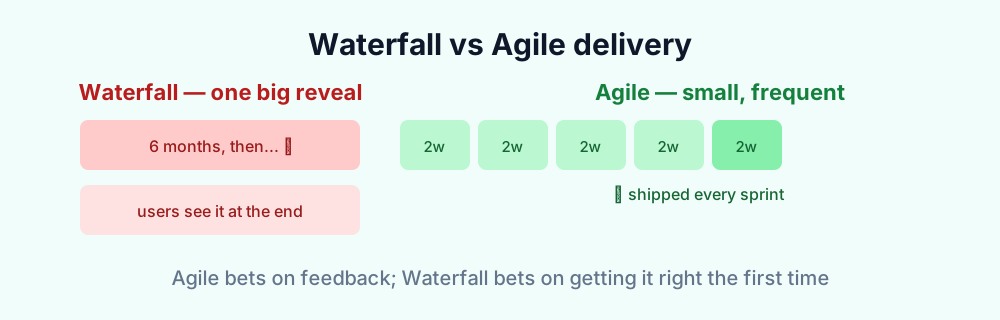
Here's the practical difference. Waterfall bets that you can get it right the first time — requirements, design, build, test, all in a straight line, with the big reveal at the end. Agile bets on feedback — you ship something rough every couple of weeks, watch how people use it, and adjust. If you're wrong about something, you find out in two weeks instead of six months. That's the entire advantage.
Scrum, Kanban, and other flavours
Agile is the umbrella; the frameworks are the rain. The two you'll hear most:
- Scrum — fixed-length sprints with specific ceremonies (planning, standup, review, retro). Good for teams that want a steady rhythm and a clear cadence.
- Kanban — a continuous flow of work through a board (to do → doing → done), no fixed sprints. Good for teams with a steady stream of incoming work, like support or ops.
Both are Agile because both do the core thing: small batches, visible work, fast feedback. They just structure it differently. Pick the one that fits the work, not the one that's trendier.
What Agile is not
Let me clear up some nonsense while I'm here. Agile is not:
- Doing everything in two weeks with no plan at all.
- A set of tools (a Jira board does not make you agile).
- A licence to change requirements every single day and call it "responding to change."
- A way to make developers work faster. (Done right, it makes them work smarter and more sustainably — the velocity is a team's own pace, not a speed target.)
Quick answers
Is Agile a methodology? Sort of — it's usually called a mindset or a set of principles. Scrum and Kanban are the methodologies that implement it.
Does Agile work outside software? Yes, increasingly. Marketing, HR, hardware — anywhere the work is complex and the answer isn't known in advance.
Do we have to use Scrum to be Agile? No. Scrum is one path. Kanban is another. If neither fits, you can still be agile with a board and a feedback loop.
Tip: Agile runs on cadence — sprint reviews, retros, planning, all on a recurring schedule. For distributed teams, a ClockHive check of everyone's timezones before locking those recurring invites is the most underrated thing you can do for the process.
Helping remote teams and global professionals master time zones. We build tools that make distributed work effortless.
🌍 Never miss a timezone tip
Get the latest guides on remote work, timezone management, and global team productivity.
Create Free Account